Sunday, 14 December 2008

Some amazing pictures of our bettas

Mesmerising pictures of some of our bettas...Many are ready to spawn, of course. Some of the pictures as just awesome, while others are so-so. While some of the finnage of the bettas are not so great -- cause of the torn finnage, collapse finnage, or any of the combinations, these fish are still very much agressive and active. Ever wonder how to keep in excess of 100 containers around? The growout tanks still have lots of torn-tail males :( ...

What's lacking is pictures of the females, but there are just so many of them and the females are a lot more beautiful (at least they don't have torn finnage much yet!). Specially, long fin giant females are just awesome, with very large caudal spread. Perfect for breeders.

The pictures of males here are combination of HMPK and HM lines we're having. Some of them are giants (but it's so hard to show their gigantic size on the pictures). None of the pictures here are touched (either Photoshopped or else!). What you see is what the fish look like, in their full colouration (though sometimes our lighting isn't much of a help, only using 1 lightbulb LMAO :) The only thing done for the pictures are: cropped, then resize to viewable image (640x480 px).

Some fish refuse to be taken pictures. Also it is worth noted that we only use 1 single tank for all pictures, hence all fish are required to be in their best behaviour in the matter of 5 mins, otherwise they're not pictured (hence you see them behaved accordingly :D)

For those who are interested on the fish, feel free to contact us (email us). Their cost:
  • HMPK = $20, pair = $30
  • HM (or SD) = $25, pair = $40
  • giant HMPK = $35, pair = $50
  • giant HM = $40, pair = $55
  • breeder quality female, buy single $40, buy as a pair add $20 to cost of pairs.
Note that HM term used above refers to HM line (whether the fish is OHM, HM, SD). Some giants achieve SD due to "mistreatment" from us (not having enough containers), however they have very nice gene and if you manage to spawn them (and give good care to the fry), you'll be rewarded with very nice lineage...

For those wondering, breeder-quality females are the ones with very long (for HM lines) and wide caudal with some desirable properties such as 180 degree or 8 rays, (if you prefer rosetail female for HMPK, mention it to us, only very limited numbers avail), etc.

For sydney-siders, meeting can be arranged. Shipping preferred, to east coast $25. You can also take the opportunity to get some of our "rejects" if you're interested. The rejects are the ones that are round-tail, Delta, or simply we think not worth selling (though they are not sick, still very active, and breedable just as other fish that we have!).

Oh, finally, none of the fish shown here have any weird defects whatsoever. Their "weird" shape on the pictures came about when they move so suddenly or agressively during photograph sessions (wish we can ask them to stand still!!). Pay attention to some of our greens ;) Oh, if you have sufficient bandwidth, watch the movies too. There are 2 movies uploaded and they are worth watching! When we said they are agressive, you know what we meant! Most if not all of our fish are just as agressive as shown in the movie (and the pictures).... Notice how wide and big they open their gill during flares (considering we only have 1 tank and they're being swap in/out quickly into the tank, but no, they're ready to fight as soon placed in the tank!)

Enjoy!

marble

go away!

giant SD

giant HMPK

giant HMPK

weird dotted colour

another green boy

another green boy

bull fight?

war dance

dont mess with me!

marble

copper boy

copper gold

copper gold

red giant

marble

copper marble

copper black

copper boy

green red

u started to annoy me!

multi

green red

another dalmatian

marble

Piss off

green HMPK boy

dalmatians

multi

2 dalmatians

white green

giant white

giant SD

what r u looking at!?

giant boy

copper boy

white marble

Finally, enjoy the most beautiful green....
green boy

Watch video on our right-side of blog, otherwise check it out on youtube link below (worth your download time!):
  1. agressive boy
  2. HM boy
Enjoy!!!

Saturday, 13 December 2008

OHM in females

It's been awhile since we really see OHM in females. Usually we don't really take much note on it, but recently we are started to see a number of females advertised as "OHM" when they are, sadly, nothing more than HM-line with SD form. Perhaps some of those sellers need a little whack in the head for calling their females OHM when they definitely are not....

Okay, sometimes you've just got carried over....understandable....it's very frequent for us just to call our fish "HM" for instance, despite some of them are very well be SD (not getting 180 degree yet). But at least there are so many of our fish that are full HM and OHM, we simply label them "HM" for simplicity.

It's rare in our occasions to call our fish OHM unless they really are. OHM carries its own "weight" in discussions, as far as we concerned. While HM is considered a generic term for a particular line, just like we call a betta CT, PK, etc. Well, any HM line is the line that *mostly* produced HM fry. Sure, sometimes you have SD in the spawn, but the proportion should be minimal, otherwise the whole line can't be called HM (cause it's proven to be still not stable).

On the same token, rarely you see fish labelled as Delta anymore, cause they're just too darn difficult to produce these days (unless you're miserable in crossing HM to a PK, or your HM line is just still too unstable, still need a LOT of work!).

Anyway, getting back to OHM in females. So far, it has been very difficult for us to get a good OHM females. We've got quite a number of them as OHMPK, thanks to rosetail gene mostly. There are quite a lot of HM females in our spawns, so this is a good indication that OHM females are not far off....Today, for instance, we only have 1 OHM female in stock. She has nice long tail and hopefully will grow much longer. Again, we suspect thanks to rosetail gene...

Note that the goal of getting OHM female is *not* by crossing them to DT. Crossing anything to DT achieves large caudal but not necessary producing stable ST line down the track. You may get good HM or OHM females by crossing to DT, but once you work for a couple of generations outcrossing them to ST, you'll lose the advantages delivered by DT gene, which further requires you to outcross to another DT...It's like addiction :)

So far, we have only known 2 breeders who have good ST lines. Their lines are purely ST and produce large HM/OHM finnage on both males and females. As usual, it is still a secret how they achieve the lines. Perhaps some day they'll share the secrets. We suspect it takes very careful planning and diligent outcrossing to maintain the ST lines (e.g. if you've got minimally 5 or 6 spawnings concurrently, and crossing the best ST to each other, you're deemed to achieve stable nice ST lines that you desired)....

Why would OHM female matter? It's because they contribute greatly to the outcome of your fry. OHM females will give you pretty much guarantee that most of your fry will be HM, with most males would be OHM (provided you've got decent male of course -- but decent males are very easy to find these days). That's why a good OHM female is priceless :)

Thursday, 11 December 2008

Update on the fry

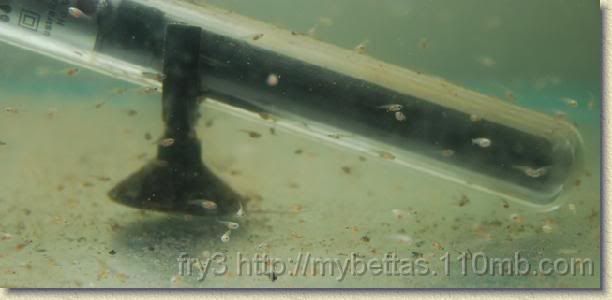
Another couple of days of growth and it gets more apparent of their size. All are single tail, as expected, which confirms our goal on achieving OHM without DT gene. Both parents are single tail but have large caudal sizes. Looking forward to see these guys grow with large caudal. Kinda interesting to see what to do with them all though, a single spawn of about 400+ fish, all of which are long fin.....at least we've got 1.5 months or so to find housing for them

Here's the pic, zoomed in to a small portion of the tank, complete with gunks

fry3.jpg fry 3 picture by breedingsmybettas

They've enjoyed bbs and mozzie larvae with ease. Some have started to pick on the worms too, only a matter of days when they start to hassle the worms properly....Need to get some larger mozzie larvae too, otherwise they'll be bored....

Talking about larger mozzie larvae, they're quite cute when chasing that bigger larvae. They know they can't eat them, but they like to pick on them and somehow manage to kill off the larvae, perhaps because of the injuries sustained during the attacks....

Tuesday, 9 December 2008

Difference between old HM and giant HM

Lots of sellers sell "old" HM as giant HM. This is simply because some old HMs do have tendency to have very large finnage (refer to long tail discussion). So the question is....how would one differentiate old HM from giant? This assumes that sellers lie about the age of the fish (either intentionally or not....it's ridiculous for instance to see an 8 months or even 1 year old fish being advertised as 3.5 months old, cause you can really see that the "boy" is old!)

To start, the body length should be different...but then some old HM also have longer-than-normal body length, therefore this is not a good indicator. Sometimes you can see from the "face" of the fish that they are giant, this is typically true when the fish has much larger body size (volume-wise) and yet the face looks like he's very "young".

Another indicator is the length of the finnage. Giant HM should have very long finnage or looks wavy despite their young age (sample pictures). Guided with this comparison, we would expect that some 1 year old large-size HMs will be equivalent to a 4 or 5 months giant HM, at least on size comparison. You will still notice that the "face" differences.

As for movements...it is quite difficult to differentiate between the two. Both giant HM and old HM should be "quite" active. They move slower than their standard betta counterpart, but still active. However, the biggest differentiator would be how long they can hold off that finnage during flare. Old HM gets tired easily, whereas giants stay active for sometime before they get bored too (they maybe bored, but if given new flaring partner, they'll flare continuously).

Another nicer indicator though sometimes quite difficult to notice on young giant would be the width, volume, and scales. Giant has thicker and bigger scales as well as much heavier volume. While giant HMPK is very much noticeable and differentiable in their volume, giant HMs are typically slimmer than their giant HMPK counterpart. However, even a slimmer giant HM is still bigger and larger (in scales and volume) compare to old large-size HM.

Note that we are not trying to compare giant HM and "standard" HM, cause there is no comparison. Giant HM is much larger than standard HM as shown in comparison. We're trying to compare giant HM and the "fake" giant HM (e.g. old large-size HM). For instance, the fish in long tail discussion is standard HM with an unknown age. It is not a giant despite its sheer caudal size. Notice that it has skinny body too which confirms that it is of standard betta.

Interestingly, female giants are a lot easier to spot, if they are long fin. How many of those old large-size HM females that can reach the length and size of a giant? A 3 month old giant HM female would have beaten the size of an old HM female easily, hence there isn't much point of trying to compare them. Note that all of the above comparisons, including body volume etc, would still be applicable when comparing giant HM females and their counterpart old large-size HM females.

Perhaps the problem with giants these days are comparatively to the discussions that we used to have about 8 years ago, when we tried to identify whether a particular betta is a "good" HM or not....Back then (and still now, but less so), a full 180 degree fish is easily identified as HM but spawning 2 "HM" won't necessarily get you HMs!!! In fact, in the old days, we used to get majority of SDs (which cost considerably cheap compared to HM!!! HM could cost from $100+ while SD only costs $40). That's because the HM gene isn't stabilized yet but also because of a number of other reasons such as:
  • seller doesn't tell the truth (e.g. is it stabilized giant gene? is it 50% giant? is it 75%? is it 100%?)
  • seller doesn't sell good giants (for the interest of their livelihood and other reasons)
  • ever wonder why you never get siblings when you try to purchase giants? (at least you won't get sibling giant HM so far)
  • you may only get one-off giant in the spawn of 200, hence what you see aint necessarily the "best" gene out there
Of course there are many other reasons, that's why a good giant gene HM costs so much! In fact, realistically, if you're looking for good giant HM either male or female, you will end up paying about $100+ per fish. Many people don't really get this as yet....the cost is expensive, but that's the price someone ought to pay for such a hard work on the "line".

For those not quite clear yet, giant HM carries the following difficulties in "producing" them:
  • it's HM (it is difficult to stabilize HM gene)
  • it's giant (no one can stabilize this gene yet -- crossing 2 giants will only get you small percentage of giants, the others are just "carrier"; same analogy from 8 years ago...crossing 2 HMs will get you lots of SD and only 1 or 2 HMs!! crossing 2 SDs won't get you HMs unless you're lucky, but that's rarely happen!)
  • it's HM (didn't we mention this already?)....HM has lots of problems associated with them which requires regular water changes, consistent care, etc
Now, some of you may say..."so what?"....well, did you know that HM is purely "hand-crafted"? There is no such betta in the wild that can be called HM (there are PK, VT, etc, but not HM). The HM fish that we've got today is totally the diligent work of their creators, over 100s or 1000s generations, to produce a very nice consistent form what we know as HM today. This is exactly the same process that many of us giant breeders are going through at the moment.....hand-crafting the ultimate giant HM. That's why some people including us love to breed "quality" bettas...we like to be "god" or at least feeling like it...

So, for similar interest enthusiasts out there....go breed "better" bettas, not just any crappy bettas (though this is very much up to the debate; perhaps for another discussion). Make sure you also help the mother earth and try to preserve wild bettas too. Don't cross your wilds with any designer bettas!

Hope this discussion helps you appreciate giant HM more. Don't be surprised if a seller asks for an arm and a leg for their giant HM, if it is good gene, it worth all the money! (provided you know how to make use of it too!)

OHM without DT gene

It has been known that DT improves the tail spread in bettas. However, recent development in HM has produced a large number of bettas with very large caudal without the aid of DT gene. This is apparent when the fish is crossed and all fry came out ST after a number of generations (despite both male/female are very large HM/OHM caudal fish). Another alternative would be to cross the fish to a known DT-carrier, if the fry produced DT, then you know there is DT gene in the questioned fish.

There is nothing wrong with DT gene at all, but sometimes it is quite annoying to get DT in your spawn when you're aiming for ST. If they are balanced DT then usually this is okay, but when they are imbalance, hmmm.....you grew disappointment.....

Recent crosses that we've done with very large caudal bettas have produced nice (and large) caudal fry ST. This is very much encouraging. It indicates how much persistent and selective breeding has produced a much stabilized betta quality (for better or worst).

Now, if you were to question how would you know whether a particular fish carry DT or not?? That's quite difficult to answer apart from asking the breeder directly. There are also some noticeable indication such as wide-base dorsal on the fish (note that large dorsal alone is NOT indication of DT, lots of ST fish have large dorsal), a bent/collapsed caudal usually in the middle of caudal (this is usually the place where the DT gene starts to split the caudal; again note that sometimes bettas torn their finnage in the middle of the caudal, hence it could be just indication of healed torn), excessively wide caudal-base with slight bent in the middle (indication of DT gene that didn't come out to fruition). Other than these indicators, you'd be safe to ask the breeder directly on it. Most breeders are quite happy to let you know the fact, though some may not have a clue about the history of the fish to start with (hmm.....perhaps they are reseller? or they've got too many spawns?)

A very nice OHM would be the one that has very balance caudal rays branchings, uniformly spread, uniform length, and finally accompanied with large dorsal and anal.

Feeding and the art of rearing fry

Most would definitely suggest to feed your fry smaller meals but in much frequent intervals. While this is true and will ensure your fry getting large in no time, it is sometimes the luxuries that everyone can't afford.

What we found, however, is that we can feed our fry in larger meals provided we "condition" them for it. Initially, on the 2nd day after hatching, we introduced bbs straight away to the fry. This feeding only contains small proportion of bbs. On a spawn of 300-500 fry, we gave about quarter-feeding of bbs (1 feeding is a 3L orange-juice container filled with bbs eggs on its surface). 1 full feeding could be spread for 1 day (feeding 4x, each a quarter). For the first 3 days or so, you'll notice that lots of bbs getting wasted as the fry still learning to adjust their eating habbit.

No worries, you can suck the gunks with airline tubing and spoon back in those fry that was sucked out to the tank.

On subsequent feedings, however, you need to give the fry a full half-feeding on each time. This means, you'd need 2 containers running bbs concurrently (each container needs 24hr hatching time, hence runnning them side by side with 12hr or 24hr apart will ensure that you've got sufficient bbs). Surprisingly, there shouldn't be much bbs gunk left over after each feeding (though you still need to suck out the egg-shell). The number of feeding per day is therefore reduced to only 3x. This will go on for yet another couple of days.

Then, you will need to reduce the number of feedings per day to only 2x. You still need to supply half-feeding container each time. The only difference is that instead of filling the container's surface to be full with bbs eggs, you need to increase the amount of eggs with additional 50%.

For those who don't know how much is a half-feeding bbs, it will be about 200ml to 300ml sucked bbs full of orange colour. Yes, don't be surprise, that's the amount of bbs you'd need to properly feed couple of hundreds hungry fry.

Each bbs container will only last for 12hr anyway, hence you need to feed 1x in the morning and 1x in the arvo. Sometimes, if you're really persistent, you can get 3rd feeding at night, but usually the water will start to look foul. No harm to the fry, but just ain't clean.

bbs is good for the fry cause they are just the "right" size. Most fry till the age of 1 month is quite happy with bbs. bbs lasts for a good 1 or 2 hours in the water too. This is good cause fry with full tummy can empty their tummy and have a good snack once they started getting hungry on the not-yet-dead bbs. Make sure that you put other live food such as black worms in the tank though...This will encourage the older fry to start "picking" on the worms when they are hungry. This avoids the problems canibalism in your tank -- for better or worst, they are fighters and they *eat* anything, including their much-smaller siblings!

Sometimes, you can get creative and feed your fry other variety of live food. Mozzie larvae is a good choice. Just make sure to feed them newly hatched larvae (about 1-4 days old). As long the fry can fit them in their mouth, they'll love you for it. We've feed our fry mozzie larvae when the fry is 4 or 5 days. Seem quite happy for it (though sometimes it is proven difficult to get sufficient larvae).

Unless you don't have much choice, we suggest you to avoid other foods for your fry. Cooked egg yolk is a last resort, cause it'll foul the tank irrespective how clean you try to change the water. organism that lives in green-algae water is also a no go....too much trouble to clean up the tank at later stage (green algae is pretty impossible to clean up without damaging your fry). We just never tried dried food, none of our fry seemed to be interested in dried food.

If you've got smaller spawn, the above food alternatives might work well. Sometimes you can put lots of plants in your tank (provided they look like "jungle" with lots of living visible organisms). This is also very good for your fry. Unfortunately, some plants just die off when you put them close to heater -- remember your fry requires constant 25-28C temperature, most plants simply die off when placed in this prolong temp. Note that you need to be able to see those living organisms. If you can't see them, then that means there won't be anything for your fry to eat.

Gravel has never worked for us on the rearing tank. Just too much of the bbs ended up sinking between the gravels, making the water a lot faster to get foul. Small filter wasn't necessary either, but then existence of filter never hurts the fry, hence it's just a "luxury" in our setup. Bubbles can help but also not necessary. If you have it, run it off like quarter-a-second apart between bubbles for the first 2 or 3 days, then increase it to about a tenth-second gap between bubbles (or faster). Don't be afraid that the bubble "disturbs" some fry, on the first 3 days, they'll learn how to swim between the bubbles...Other people may suggest you to run 1 bubble per second, that's just pretty useless. You need the bubble to move at least a quarter of water in your tank. if it's just a bubble per second, it won't achieve anything.

The "rougher" you treat your fry in the early days of their lives, the "stronger" your fry will turn out. We practically pour bbs water to the tank, put strong bubbles (sometimes), etc. The only requirement that we never broke was to keep tank temp stable. Fluctuation in temp will just cause too much problem, including whitespots and icks. Hence, if it's possible, do not temper with your thermostat!!

Happy rearing....

Saturday, 6 December 2008

More pics of the fry

Just want to record how fast these guys develop. 2nd day eating bbs and their size is amazing already. The whole tank is full of them, perhaps in a week time would be good time to split them up, too overcrowded....

Here are 2 pics coming from one corner of the tank....

fry 2

fry 2

Friday, 5 December 2008

long tail as ideal betta?

This has raised a lot of previous discussions, IBC, forums, etc also had discussed this. But what is our ideal bettas? In our case, we love to have bettas with the following characteristics (only for long fin):
  • tail very long, the longer the better
  • has to have desirable HM form, e.g. 180 degree, large dorsal (not bent!), large and squarish anal
  • no DT gene (or not a direct carrier anyway -- how to know? cross it with an ST with DT carrier, if none of fry is DT then we're good)
  • round circle connecting caudal, dorsal, and anal
  • 8, 16, or 32 rays branching, as long the fin is fully expanded and show off beautifully
  • little or none rosetail gene (misalignment of scales, fin ruggerized)

If possible, the caudal length is as long as the fish's body, if not longer.

Now, many would complain that the betta would look like "dragging" its tail....Well, no...majority would be, since that's not "good health" bettas. Good bettas would show off the tail very nicely and flare actively without much of dragging. Only old or weak bettas will drag their tail. Unfortunately, finding such a betta is very difficult, since you have to rely on your eyes to spot the right pictured one.

Due to the above weaknesses, many breeders have preferred a much shorter tail. Well, that's not something that we fancy. To put it simple, it's easy to produce shorter tail bettas, hence there is not much challenge in it. It's a lot more difficult to produce consistent long and strong tail bettas!

Long tail carries extra problems too...water needs to be extra clean, otherwise finrot will just crop up like bush fire. fry needs early separation as you definitely dont want that beautiful long tail torn to pieces.

We'll find more pictures on what the bettas would look like, but if you check our previous posts, you'll find some of them (copper pictures here and here for instance). They are very beautiful when flare and the way they move....

Here are examples (permission given by seller):
caudal longer than the body

large caudal

Note that there are more improvements for the above 2 pictures such as dorsal/anal areas, however the point of discussion at the moment is the caudal. Also, we don't know if any of these 2 fish "drag" their caudal or not, cause the static pics don't show that. However, given their apparent agressive outlook, we can assume that they're okay....

Here is another example of large tail, accompanied by large body. This fish seems old as well (and well fed ;). It is confirmed that this one carries DT as indicated by the volume of the tail. Not sure if the above 2 fish carry DT, but suspect they are.

big caudal

Interestingly, the larger the finnage, the more chance of heavy branchings happening, hence the more chance of feathertail occuring. Nothing wrong with this, in fact it looks even nice as it indicates the beautiful branchings on their tail (we've start off with 1 or 2 branchings on typical bettas to 16 or 32 branches, even up to 64 branches). As long they don't form extreme rosetail, they just look nice, don't you agree?

Wednesday, 3 December 2008

Some possible nice dragon colours

Suppose there are some betta colours that you want, what would that be?

Today, it came to our mind that we'd like to see/produce some of these colours, perhaps much much later down the track:

  • platinum blue -- full dragon white masking, over black body, but full royal blue tail (they manage to get nice red dragon, why can't we get blue dragon)
  • black dragon -- combination of black orchid and full mask platinum/copper shading (better yet if someone can get superblack or melano dragon)
  • orange dragon -- same as full platinum red, but we'll have orange as the base instead

Those are just some ideas for the dragons. When we say dragon, we don't refer to "slight" highlights on the body, no....we mean full masking with very strong white colouration where each scale is clearly marked. there are "cracks" between the scales, that's dragon!...tail and body colour need to be clearly defined... many fish labelled as dragon these days are no more than typical masking and most are even very much disappointing in it ! Those sellers should be shame on calling their fish dragons when they do not deserve the title....

There you are, some ideas for you, if you'd like to get some challenges in producing nice bettas :)

CSB = Community Supported Betta

Just got an idea after watching the "The Real Dirt on Farmer John" where he went through the full process of conversion of his farm to be CSA (Community Supported Agriculture). More references here http://en.wikipedia.org/wiki/Community-supported_agriculture.

Well, the idea is pretty much the same. We loved bettas, bred bettas for its enjoyment, but the associated cost of such hobby is pretty high. So, what if we have something similar to CSA whereby a bunch of enthusiasts pool some cash for a spawn?

It boils down to something very simple:

  1. find a pair that everyone interested in
  2. acquire the pair
  3. "shareholders" pay for part of the cost
  4. at the end of 2 or 2.5 months, all shareholders will get their share of the spawn

Deciding the cost is a bit difficult though, so let's run some numbers just for the sake of arguments:

  1. buying fish $150 ($80 for a pair in AUD!, $50 for transhipping, $20 for local shipping)
  2. electricity $100 (breeding tank, fry tank, growout tanks need to have heater at least for the first 1.5 month for consistent temp)
  3. foods $50 x 4 ($50 per 2 weeks pro-rata, fry eat lots of black worms towards 1.5 to 2 months old)
  4. breeder salary free (for now, assume it is free)
  5. shipping to each shareholder $25 x N

So, the grand total of the cost would be about $450 excluding any shipping charges incurred.

Now, suppose we are looking at 5 people as shareholders, then you'll be looking at $90 for each shareholder to pay up. Of course, the greater the number of shareholders, the smaller the cost. Some cost reductions can be done as well, perhaps by purchasing cheaper parent fish (but remember, shareholders may want to stick with "good quality" fish, hence not sacrificing too much on this). Similarly, foods also fluctuate based on the number of fry etc (and whether it was agreed to use pellets for instance -- though most of our spawns use live worms). Electricity maybe reduced, depending how well summer coming in....

But then you'd think...hold on....isn't that pretty much equivalent (more or less) the cost of buying 1 pair of bettas for myself? Well, yes, but then what you get at the end of CSB would be LOTS of fry to be spread to shareholders. Assume that each spawn yields between 25 to 300 fry, then the bare minimum number of fish each shareholder receives would be 5 ! The breeder may want to keep a couple of fry for himself as well, but you get the idea....

The quality of the fry is usually pretty high, but this depends heavily on the initial seed. Hence choosing good parents would be one of the fun thing for everyone to decide on :)

Let us know what you think of above. If you're interested, we're more than happy to try it out on a single spawn. Perhaps with this approach, we can share good betta genetics much faster in the community, rather than individuals trying on their own.

Tuesday, 2 December 2008

New breeding season!

Some of our guyz got their act and produce young and healthy fry. Here are some pics of them (still need to work on the skills, zoom and focus pretty much challenging)

fry anyone?

fry anyone?

zoom in fry

Can't seem to zoom in properly, but anyway, that's good enough.

So small...they are actually giants, but definitely can't tell the difference when they are so small.

Monday, 1 December 2008

Comparing our boys

Sometimes it is fairly hard to visualize what a giant looks like, particularly if you never seen one or when you only see one individually on picture.

Here is the comparison images that we took, not the greatest ones, but sufficient for you to compare what they really look like.

On these pictures, you see normal HM boy and giant boy. Both of them are nearly 3 months old. Don't be fooled to see that the normal HM is "shorter" on the tail, no he's in fact has pretty darn beautiful tail, it's just that once he's put together with the gigantic boy, his tail does look shorter :)

compare the boyz

compare the boyz

compare the boyz

They manage to flare for sometime before the normal HM boy decided to run off. The giant is just too big for him :) Time to condition the giant for breeding, crossing him to his half-sister.....

Wednesday, 26 November 2008

Breeding experience, free fish!

A recent request just reminded us on how precious sometimes to gain the "experience" to spawn bettas. We've taken spawning as granted and forgot how difficult it was to do a successful one (or even a failed one). Still remembered a long time ago when a group of us had to travel back and forth to aquariums every single week (for months!!!) for a wish that we find the "right" fish. Heck, back then, any HM line was seen as gold. In fact, these days, it is still the same!!! Try to
go to LFS and hope to find an HM line male or female, tough luck....Chances, if you ever see the female, it would either be plakad, veiltail, or some sort that you never know.

Nostalgia....Still remembered how we hold our breadth when they wrap, how we waited those long hours just to see the eggs falling, and agitated we were when the male didn't pick the eggs at all, or frustruated we were when the bubble kept bursting despite the best effort that we did with all the heater and tank preparation....ahh, those were the good times :)

Anyway, here's the offer. If you would like to experience spawnings, we are offering our fish for FREE! Each person is limited to get up to 2 pairs. They won't be the greatest fish you'll ever seen, but they carry good genes (heck, otherwise there won't be a point for us to spawn their parents to begin with!). Most of the times the males would be torn-fin because they fight, but that shouldn't deter you in spawning them, would it??? Long fin males most probably be Super Delta (SD). Females usually quite okay, may not be perfect either with little torn here and there. Of course you will never get deformed fish, that's out of the questions. All fish would be either HM or HMPK lines (your call which ones you like -- as long we have stock). You would be very surprised on the offspring later cause they actually carry very good genes (but we won't spoil your fun, find and discover it for yourself)....Lots of colours available, but we either pick them
randomly for you or you specifically say what your favourite colour and we see if we have them in stock :)

We don't want anything back from you. They are given to you as FREE. Perhaps we are hoping that you'd support us in the future by buying our stock (that helps reducing the cost of providing these great bettas to others), or better yet, perhaps we hope that you also do the same deed to others.

However, most of our fish are very young at this point in time, so chances you will need to keep them for at least 2 weeks to 4 weeks before you can spawn them. The ones avail for sale are quite big and ready to spawn, that's provided you'd prefer the "better" ones.

If you are interested, contact us on email. If for some reasons you were unlucky with your given pairs and would like to keep trying, give us an email and we'll arrange something (happy to sell some pairs for very reasonable price).

How do you get them? We're in Sydney, so if you're in sydney too, meeting could be arranged (though very much difficult on timings, give your phone #). Shipping can be done as well if you live in other cities, cost $25 to eastern coasts.

Spawning experience is one of the reasons why we've been in bettas for awhile. The excitement, the disappointment, the success, and the failure. Hope we can share that experience with you too.

PS. We still encourage you to support fellow breeders (including us) who are offering their stock for sale. Consider this offer as supplement to those with cash-strapped pocket, hopefully the offer takes a bit off of your stress or allow you to experience breedings :)

Good luck and happy breeding.

Monday, 24 November 2008

Giant gene to enhance bettas

Some have asked whether this is true. Well, yes. Giant bettas, if you choose good ones, will enhance your typical bettas gene.

See, the trick is in the sheer size of the body. This will improve the size of your bettas and increase their form as well.

Of a particular experiement, we've found that normal bettas will increase in size once bred to a giant and this will stabilize on at least 2 generations, e.g. F1 will give you lots of 50% giant with improved genes already, F2 will get back to majority of "normal" bettas, but with slightly larger size. Robustness of the bettas also improve.

Interestingly though, if any of the fry carry (and reflect) heavy rosetail trait, then their size is no difference than normal bettas. This is perhaps the effect of extreme rosetail. Furthermore, while "normal" rosetail will have detrimental effect on bettas' size and health, a giant that carries rosetail is in fact seems much healthier and active (though this could be just a particular spawn that we have -- we need to monitor and do lots more experiementations to see this).

Another interesting observation is on the thickness of their finnage, or rays. Normal bettas with very weak rays can be improved by crossing it to a giant. It improves the strength of the rays.

As with any spawnings, you need to choose your breeders carefully ! After all, the spawns will inherit the good and bad traits from the parents.

Wednesday, 19 November 2008

beaten HM

just one of those days, when 1 of our giant HM male is beaten by a female....failed in spawning, of course.
he's still flaring, looks to be still okay, but isn't really in any good shape to continue the spawning attempt. well, that's the outcome of getting one of our 2.8 inches female to be crossed to long fin 3.7 inches male, a big failure. instead, we have the female happily snapping bits and pieces of that beautiful long finnage of the male :)

resting time for this male, just for another try, perhaps with much smaller female

Sunday, 16 November 2008

copper red and reverse BF boyz

copper boy hm giant

copper boy hm giant

reverse BF red boy


The copper red boy doesn't have that white patch on his body (that was just the unclean tank). We may want to keep the copper red boy and sell the reverse BF boy....still not sure as yet. that reverse BF boy forms a very nice triband already. A bit of growing, hopefully he will turn out great :)

Quite exciting to see their progress later. They are barely 9 weeks old and their size already equivalent to standard HM betta of 3.5 or 4 months old. Notice also that they're very naughty boyz, lots of nippings already! In fact, they started doing the nippings when they're about 6 or 7 weeks old, we ran out of dividers, so they're just left in the growout tanks for awhile.

Branchings seems to be good too. Started on 8 rays, but hopefully will get to at least 16 rays.

These guys are only available on very limited number. There are only 4 pairs of them on each spawn. Well, there were only that few hatched to begin with, due to the extreme size of their mother and father. Their mom was the 3.5 inches HM giant and the dad was 4.2 inches in length. We will keep at least 2 pairs, and may offer the others for sale. Offer us the right price, their siblings could be yours ;)

Edited: sorry, the images didn't show up before, fixed now (we think...testing with FF). server host doesn't allow hotlinking, oh well...posting the images somewhere else then ;)

Thursday, 13 November 2008

dilemma dilemma

being able to get giants, very large size ones, is difficult enough.
spawning them is pretty much impossible. knowing that the larger the
giants, the chances of them being old is also greater. most giants
offerred barely makes 3 inches even for HM. 3 inches!!! in case you're
not aware, a true king giant betta of HMPK should reach 2.5 inches at
the age of 2.5 to 3 months easily. they typically get 3 inches in 4 or
5 months time. so, having long fin HM giant to only get to 3 inches
including tail at, say, 4 months time is very disappointing.

there are some giants on offer for quite reasonable price (well,
they're still expensive, but at least not one of those exaggerated
price of 300 bucks), however if you notice it carefully, they are
"old" giants. i wont be surprise if these giants are at least 8 to 9
months, if not 1 year old. sure, someone maintain their water well
(you can see this by the beautiful finnage that they're still having,
despite such "old" age). these giants typically 3.5 inches in length
including tail, but what you gonna do??? that's the "best" on offer.

we're lucky enough from time to time to get some good connection with
breeders. they're quite willing to sell us much larger giants, say 4+
inches. these giants, again, won't be surprised if they are 1 year
old, but at least they HAVE large size.

now, all of the above are males. what about females? well, females are
much smaller in size. this is in contrary to what we experience in our
breedings for short fins giants. our hmpk giants have large size
females compared to males. maybe because we feed them very well, with
all the live food and all. getting back to long fin giant, you will be
lucky to find anything closer to 2.8 inches. but hey, you may wonder,
isn't 2.8 inches female giants hmpk are pretty easy to find??? YES!!
that's the disappointing part. we have produced many 2.8 inches female
hmpk, so that size isn't so much special for us at all anymore. we
would expect HM giant female to reach at least 3.5 inches. indeed we
found some of this size. how old are they? again, perhaps 1 year old.
they certainly seem and behave "old". how do we tell? well, the older
fish has less desire to flare, specially gaints. they're so big, they
won't even bother to flare to smaller fish (i wouldn't bully smaller
fish myself, if i were giant, just a waste of energy). they flare okay
with larger males though, in fact not only they flare, they fight them
off!!

this is the problem with us now. getting very large giant female will
mean we are on the quest to find suitable male. none of those males on
offer is suitable for these females (same experience that we've got
with our 2.8 inches hmpk females -- would be lucky to find any males
who can wrap them up). the problem is, most giant genes aren't
"settled" yet. spawning 2 giants won't mean you get all giants. mostly
you've got big fish, but there would only be about 30% pure giants,
the rest are larger fish (the so-called 50% and 75% giants). so,
spawning the largest giants you can find on earth would mean, if
you're successful in spawning them, you are producing a much bigger
chance of producing "pure blood" giants. this is particularly one of
the biggest challenge that we find with HM giants. in fact, this is
the same problem faced by the thai people as well...do you notice any
surprisingly large and beautiful HM giant? if you keep your eyes
peeled, you'd notice "no"! so, at least we are on the same position as
the thai on this problem. inability to produce very large giants. one
of the dreams of ours is to produce the infamous 7 inches giant!! full
hm with good forms, of course.

we find that breeding hmpk giants are easy now, it isn't much of a
challenge anymore. sure, too large females mean difficult spawning,
but at least we can produce consistently large giants in our spawns,
and that's very much good for us already. their forms are very nice
already, colour may need improvement, but then we aren't focusing on
color sometimes either.

breeding largest HM giants, with very good (if not the best) form, is
the biggest challenge now. we only see 1 giant over this couple of
years being produced in very perfect form, but that was a "one-off"
spawn. the breeder is no longer able to produce that kind of giant
anymore. this giant had the size of nearly 2x standard long fin HM.
now, that's about 4.5 or 5 inches, for those who are wondering.

oh, did we mention that the "older" the bettas, the more difficult
they are to spawn? they are no longer active, their eggs got older
too, and the males typically got tired very easily (what do you
expect? he has to drag that large tail of his everywhere!).

but rest assured, we're still determined to get, first of all,
successful spawn of large giant HM, followed by raising their fry to
extremely large size!!!

if you're asking, how much would be the price for the fry, we would
say EXPENSIVE!!! it's the difficulty on getting the spawn to begin
with. for every successful spawn that we've got with this large
giants, there are usually at least 3 to 5 unsuccessful ones. these
unsuccessful ones typically involve different pairs!!! now, try to
figure out how much money involved to get them imported etc, only to
find them wasted cause they fail in spawning....happy if you'd like to
buy the failure ones from us ;) ;) ;)

right, enough chatting...better get to watching the fish. figuring out
how to successfully spawn them.

Tuesday, 11 November 2008

Summer is coming, but that's not easier for breedings

In the hope that warmer temperature will stimulate (better) breeding for the giants, we tried out 2 giant pairs in the tanks. They're more than eager, but typical difficulties with giants still exist. Either the female is too large for the male to wrap, or she's not interested in the awesomeness of the male.

It would be easier if we had chosen smaller females. But this time, we really wanted to try our breeding skills against much larger female. The two females in the tank are both 2.8 inches and 3 inches. They are massive for such young age (3.5 months now). In fact, they look like the "big momma" (Lawrence) movie, but in a much bigger scale compared to their standard bettas counterpart. These females are paired against their sibling brothers, each of 3 inches long as well. The males are more "skinny" on the tummy, whereas the females are at least double the size on their "waistline".

Unfortunately, this is day 3 already, lots of nipping of female's tail, but no eggs. They are still dancing and flaring continuously. If they were the typical bettas, we would expect them to successfully spawn by now. Oh well, perhaps just another wait and see.

It is still interesting to discover that we are just as newbie in giant spawnings. They are challenging beasts. Pick them too young to spawn, they ended up being very aggressive (though usually successful spawning), but we dont know if we've picked the largest-eventual-giant from the pool. Pick large ones to spawn on much later time, in the hope of producing yet-much-larger giants, usually yield in disappointment cause the darn thing won't spawn at all !!!

Usually the males are to blame though. Their body is not big enough to handle the body of the female. Dying to hear back from the experts out there as to how to spawn giants the "easy" way. Let us know if you know a trick or two.

Sunday, 9 November 2008

youngsters for sale

check out our stock sample at http://mybettas.110mb.com. There are some new stock uploaded. These guys are very young, 2 months old, but has been quite a headache to keep, as most of them are very agressive. lots of nippings already happening. both males and females flare very frequently.

if you're interested, they are available for $100 for a bulk of 10 (5 pairs), random. You will get a mix of long fin and short fin, various colours. nippings exist but not very extensive, most nippings will heal in short amount of time. they are HM and HMPK. Some come from giant gene line as well, hence expect their size to grow much larger.

Shipping to east coast is $25, otherwise please contact us to see if some meeting time can be arranged (shipping is still preferred).

Email at mybettas at gmail dot com


Friday, 31 October 2008

giant long fin, why not larger than it should be?

we've been wondering how large the long fin giants can really get. some reported size is about max of 7", now that's really really large!

largest giant so far that we've seen is about 4.5 inches, and it was a short fin giant. if we consider that typical short fin giant merely get maxed out to 3.5 inches, you can see why we were wondering on this frequently....reported largest short fin is about 5 inches and its exaggerated size of 6 inches is still no way to be seen. considering we've seen a 4.5 inches, it is very much possible that such 6 inches exist, just dont know how old or how big he really is...

anyway, working from the fact that 4.5 inches giant hmpk existed, then wondering its equivalent long fin shouldn't be too hard, wouldn't it? :)

longest long fin giant hm we've seen is owned by our QLD mate DC, and that's 5 inches in length. working out backward, perhaps it is possible to have 6 or 7 inches giants. female hm giant is another different thing altogether though....largest that we've seen is 3.5 inches and DC has kept the record for 4 inches female. even with 4 inches female it is still nightmare to try to spawn them (well, we successfully spawned 3.5 inches with only 10 fertilized eggs!! and DC is still trying his heart out for the pair).

if you know much larger giants, or have pictures of them, do let us know. quite intrique on this.

Thursday, 30 October 2008

simplified sale costing

too much problem with individual costs for the fish. If you'd like to order the fish, just consider this cost:

per pair: $40
per individual: $30

shipping: $25 to east coast

order more than 2 pairs include either free shipping or free 1 fish.

order more than 4 pairs include the above bonus (from 2+ pairs), plus another fish.

we'll update what's available and what's taken from the sale page, later. send us email to see if the fish of your interest still available

btw, all of your fish ordered are guaranteed for:
* DOA - full replacement or money back on the value of dead fish
* fish arrived sick - same as DOA (if fish sick much later after arrival, that's your responsibility)

other (troublesome) condition, if happened to your fish, please let us know asap and we'll arrange something.

Wednesday, 22 October 2008

Stock updated, special delivery option for some states

OK, just got the time to update the stock today. Apologies. just too much things going on and really busy days.

Anyway, please check stock at http://mybettas.110mb.com.

Apart from standard deals such as below, some hobbyists from some states can also get special delivery!!!
buy 2+ fish: 10% off
buy 4+ fish: free shipping or 15% off
buy 8+ fish: 1 free fish

Our friend will be able to help in delivering your fish for FREE (meeting somewhere at your state) on the following date:
* Perth: 26, 27 or 28 October
* Adelaide: 2 or 3 Nov
* Melbourne: 12 or 13 Nov

Definitely got in contact with us if you'd like to buy our fish and require meeting for the fish delivery at the above location. Alternatively, shipping still costs you $25 to east coast

Update
-------
Additional state delivery by another friend (still not fully confirmed yet; can only confirm in couple of days time):
* Brissy: 30 & 31 October.
* Cairns: 8 Nov

Note, all monies need to be paid before fish delivery (our friends only want to help deliver the fish; don't want to handle exchange of monies etc). So, contact us asap and get payments sorted, otherwise our apologies that shipping will be the only option.

Tuesday, 7 October 2008

Looking forward to some nice looking giants long fin


Well, here's a sample of early riser of copper giant.
He's slightly above average compared to standard giant....well, he's not 1.5 months as yet, but looking good already.

Finnage is a bit odd, but then we won't complain cause by the look of it, he'll make it to be OHM soon...if we push him with some exercises :)

His video action below can be seen in YouTube at MyBettas YouTube

Monday, 6 October 2008

Check out our limited new stock!

We've got some of our offspring from last spawns, thanks heaps to AB
for this lot.

Anyhow, go to stock link at our new homepage http://mybettas.110mb.com

Some limited giants HMPK and HM are available. They are young but have
large size already (2+ inches).
Some of the females will definitely give you LOTS of fry !!!

Discounts:
buy 2+ fish: 10% off
buy 4+ fish: free shipping or 15% off
buy 8+ fish: 1 free fish (cheapest free)

Contact us on mybettas@gmail.com if you're interested.